Session 4 · Connectomics
Who are neuron X's strongest partners, and along what pathway?
VFB connectivity queries and neuPrint for weighted partners; trace a short pathway.
Key question: Who are neuron X’s strongest partners, and along what pathway?
Route A: Python API
First time? Set up Python → Open this session in Colab
Two levels, both one call. For an individual, the term object serves the pre-computed partner list; for types, get_connected_neurons_by_type compares across whole connectomes.
from vfb_connect import vfb

# individual: ranked partners of one hemibrain DA1 lPN
da1 = vfb.term("VFB_jrchjtdb")
for p in da1.downstream_partners(weight=20)[:5]:
    print(p)

# type-to-type across datasets
kc = vfb.get_connected_neurons_by_type(upstream_type='DA1 lPN',
                                       downstream_type='Kenyon cell',
                                       weight=10, return_dataframe=True)
print(len(kc), "DA1 lPN → Kenyon cell pairs (weight ≥ 10)")
Verified output (Aug 2026):
Partner(weight=73, partner=v2LN30_R (FlyEM-HB:1671620613))
Partner(weight=61, partner=lLN2T_c(Tortuous)_R (FlyEM-HB:1704347707))
Partner(weight=61, partner=DA1_vPN_R (FlyEM-HB:733316908))
Partner(weight=47, partner=lLN2P_b(Patchy)_R (FlyEM-HB:1946178096))
Partner(weight=43, partner=lLN2T_c(Tortuous)_R (FlyEM-HB:1671292719))

1132 DA1 lPN → Kenyon cell pairs (weight ≥ 10)
Gotcha to teach: get_connected_neurons_by_type defaults to exclude_dbs=['hb','fafb'] (to avoid double-counting the overlapping hemibrain/FAFB volumes) — so those 1,132 pairs are FlyWire + male-CNS + BANC. Pass exclude_dbs=[] to include everything.
Route B: R (via reticulate)
First time? Set up R + vfb_connect → Open this session in Colab (R)
da1 <- vfb$term("VFB_jrchjtdb")
for (p in da1$downstream_partners(weight = 20L)[1:5]) print(p)

kc <- vfb$get_connected_neurons_by_type(upstream_type = "DA1 lPN",
                                        downstream_type = "Kenyon cell",
                                        weight = 10L, return_dataframe = TRUE)
nrow(kc)
Verified output (Aug 2026):
Partner(weight=73, partner=v2LN30_R (FlyEM-HB:1671620613))
Partner(weight=61, partner=lLN2T_c(Tortuous)_R (FlyEM-HB:1704347707))
Partner(weight=61, partner=DA1_vPN_R (FlyEM-HB:733316908))
Partner(weight=47, partner=lLN2P_b(Patchy)_R (FlyEM-HB:1946178096))
Partner(weight=43, partner=lLN2T_c(Tortuous)_R (FlyEM-HB:1671292719))

[1] 1132
Note the L suffixes: reticulate passes R integers as Python ints only when you write 20L — a plain 20 is a double and some arguments reject it. The exclude_dbs=['hb','fafb'] default applies here exactly as in Python.
Route C: MCP Tool
First time? Connect the VFB MCP to your AI →
The connectivity of any connectome neuron is a pre-computed query — the assistant fetches all partners with per-direction synapse counts and does the ranking itself:
You: For neuron VFB_jrchjtdb, list the top 10 downstream partners by synaptic weight.
Assistant →
get_term_info(VFB_jrchjtdb)→ NeuronNeuronConnectivityQuery (count 484) →run_query(VFB_jrchjtdb, NeuronNeuronConnectivityQuery, limit=0)→ 484 partners, each with outputs and inputs synapse counts → sorts by outputsAssistant: VFB holds 484 connected neurons for DA1_lPN_R (FlyEM-HB:1734350908). Top 10 by output synapses: v2LN30_R (73), DA1_vPN_R (61), lLN2T_c(Tortuous)_R (61), lLN2P_b(Patchy)_R (47), lLN2P_c(Patchy)_R (43), lLN2T_c(Tortuous)_R #2 (43), lLN2T_e(Tortuous)_R (33), LHAV4a4_R ×2 (30 each), M_vPNml55_R (30) — each with its VFB ID (VFB_jrchk8e8, VFB_jrchjtdh, …). ConnectivityPerRegion breaks the same edges down by neuropil for the “which are in the mushroom body?” follow-up.
Worth noticing: the chat route’s answer for “DA1_lPN_R” used a different individual (FlyEM-HB:1734350788) and got different counts. Individuals are not interchangeable — always keep the ID.
Example Prompt
For neuron VFB_jrchjtdb, list the top 10 downstream partners by synaptic weight, and tell me which are in the mushroom body.
Route D: VFB Chat
Nothing to install — tips before you start →
Chat can provide connectivity summaries.
Optimized prompt: Specify top N partners and ask for synaptic weights with IDs.
Route E: 3D Circuit Browser
Nothing to install — how the viewer works →
Connectivity in the browser is one click from any connectome neuron, and the table it returns is sortable and downloadable.
Open a connectome neuron. Use the button below for the Male CNS DA1_lPN_R (MaleCNS:13064). In its Term Info, the Query For section already offers Neurons connected to DA1_lPN_R with the partner count (581).
Run it. The results list every partner with Outputs and Inputs columns — synapse counts in each direction. Click the Outputs header to rank downstream partners: the local neuron v2LN30, sister DA1 vPN, lateral horn and Kenyon cell targets fall out exactly as in the Python route.
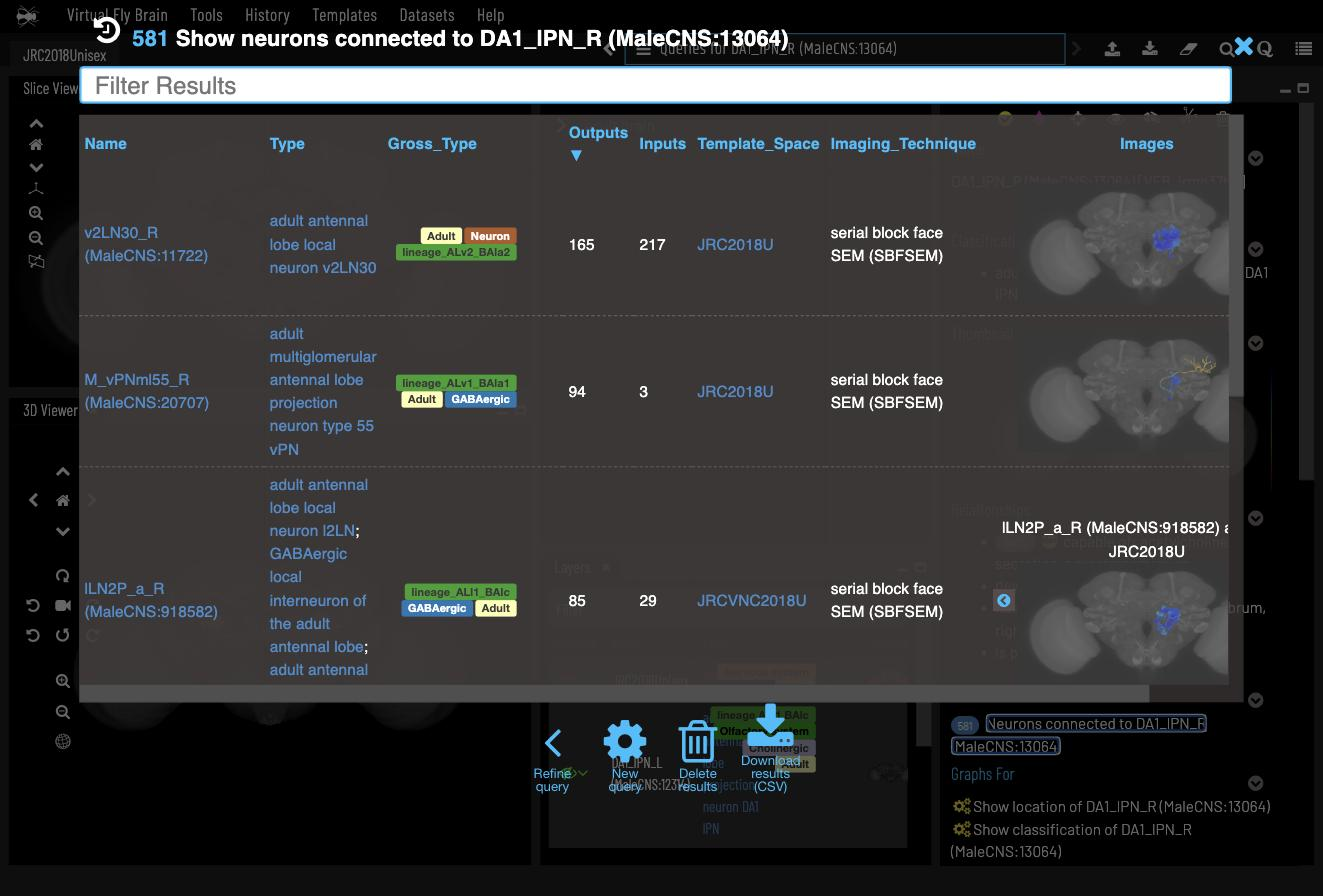
Chase the circuit. Every partner name is a link — click one and its term page opens with its own connectivity query, so you can walk the circuit hop by hop. Tick checkboxes to pile the pathway up in the 3D viewer as you go.
Take it to Python. Download results (CSV) gives you the same table with IDs, ready for
vfb_connect.
Worth noticing: the instance query menu also offers Show connectivity per region — the same partners broken down by neuropil, which answers “which of these connections are in the mushroom body?” without any code.
Try It Next
- How stable is a ranking? Run the same question on the sister individual
VFB_jrchjtdf(FlyEM-HB:1734350788) — its top partners are v2LN30_R (60), DA1_vPN_R (59), lLN2T_c (47). Same cast, different counts: how much do individual neurons of one type vary? - Which partners are Kenyon cells? At type level,
get_connected_neurons_by_type(upstream_type='DA1 lPN', downstream_type='Kenyon cell', weight=10)→ 1,132 pairs — now try other downstream types (lateral horn neurons?). - By region: the browser/MCP Show connectivity per region query breaks the same 484 partners down across 11 neuropils — which fraction of the output is in the mushroom-body calyx?
When to Reach for Which Route
- API for quantitative partner tables and multi-hop pathway analysis
- MCP/Chat to orient and get quick summaries
- 3D Browser for interactive connectivity exploration